# Recording Analysis
## **1. Explorer**
The Recordings Explorer is the main command center for managing all recorded conversations. The interface is the same for Meetings and Calls, allowing you to find and manage any activity quickly and consistently.
**Unified search and filters (1):**
The top bar lets you locate any recording precisely using criteria such as **Date**, **User**, **Company**, Tags and the **AI Score**. The only difference is the type filter: **Meeting** **Type** or **Call** **Type**.
**Saved views (2):**
You can save frequently used filter combinations as a "**View**" to access it with a single click.
**Start or upload recordings (3):**
From the top right corner, you can add new activities, either by recording a meeting on the spot **(Record Meeting)** or by uploading an existing video or audio file **(Upload recording / call)**.
**Quick actions (4):**
The three-dot menu (...) at the end of each row allows you to:
* Copy the AI summary.
* Share the recording.
* Delete the recording.
## **2. Detailed recording review**
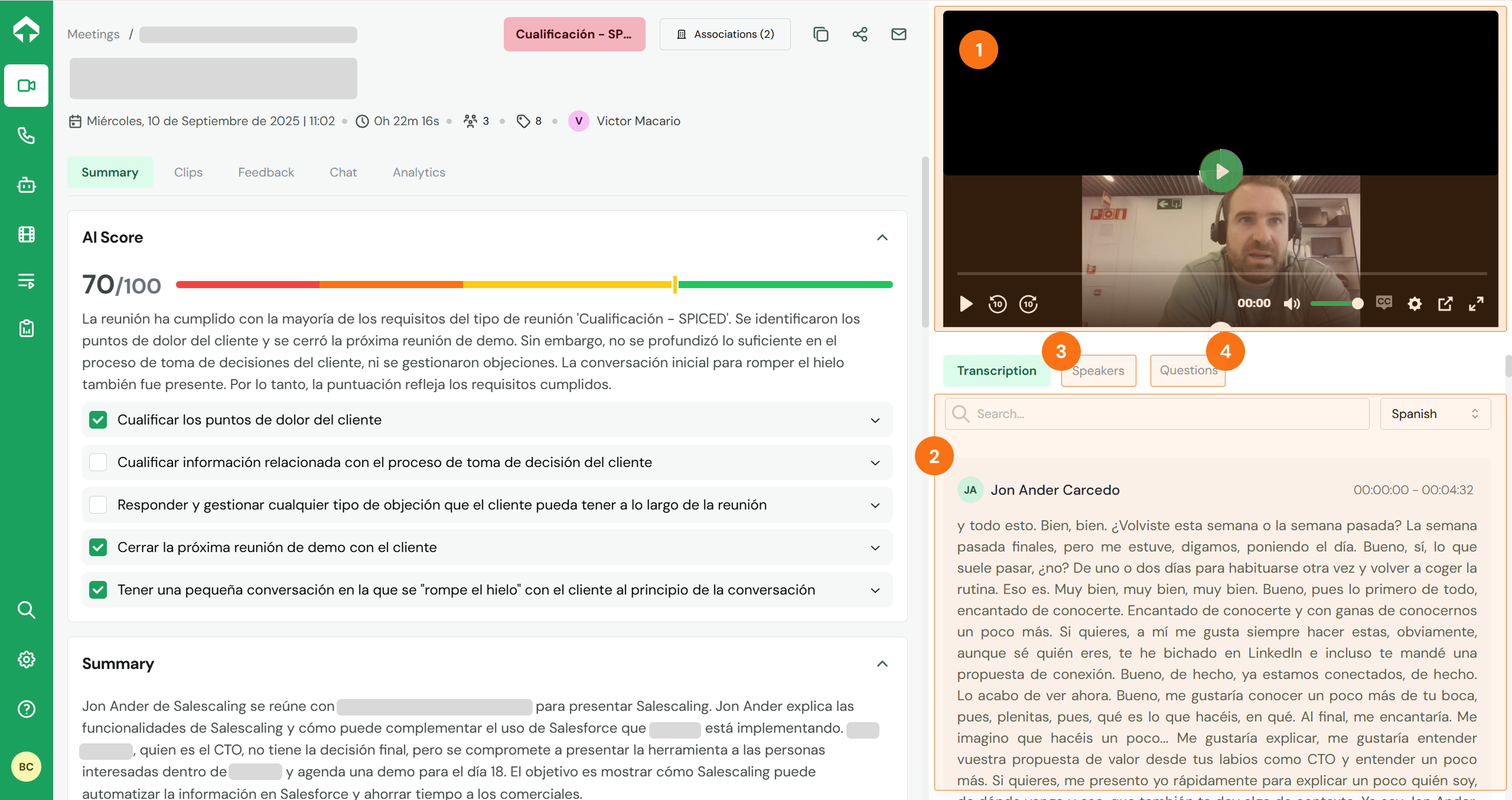
By clicking any recording from the Explorer, you access the **Detail View,** the deep analysis hub of Salescaling. The interface is the same for **Meetings** and **Calls** (except that Calls do not show the video player).
**The player and the interactive transcript**
* The right panel contains the **player (1)** and the **full transcript (2)**, synchronized with the audio/video.
* This panel has three views:
* **Transcription (2):** Full text of the recording.
* **Speakers (3):** Participation summary for each person.
* **Questions (4):** List of all detected questions.
**Analysis tabs (left panel)**
* **Summary**: Presents an interactive breakdown of the **AI Score**, where you can click each criterion to see the evidence in the video.
* **Clips:** Key moments, generated by AI or created manually.
* **AI chat:** Ask the AI about the meeting content.
* **Feedback:** Structured comments for each participant.
* **Analytics:** Charts about the conversation dynamics (speaking time, etc.).